Ataturk: Life and Legacy.
From Selanik to Ankara, the military commander who founded a republic from the ruins of an empire and reshaped a nation through radical reform.
Early life and education
Mustafa Kemal was born in 1881 in Selanik (modern Thessaloniki, Greece), then a cosmopolitan port city of the Ottoman Empire. His father, Ali Riza Efendi, was a customs official and lumber trader; his mother, Zubeyde Hanim, came from a farming family. His father died when Mustafa was young, and Zubeyde raised him largely on her own.
Against his mother's wishes, Mustafa enrolled in a military secondary school in Selanik, where a mathematics teacher gave him the additional name "Kemal" (meaning "perfection" or "maturity"). He continued to the military academy in Monastir (Bitola) and then to the War College in Istanbul, graduating as a staff captain in 1905.
During his education, Mustafa Kemal was exposed to Enlightenment thought, the French Revolution, and the writings of Montesquieu, Rousseau, and Voltaire. He became involved in the Young Turk movement and the clandestine Committee of Union and Progress (CUP), which sought constitutional reform of the Ottoman system.
Military career
Mustafa Kemal served in several conflicts that marked the Ottoman Empire's final decades. He fought in the Italo-Turkish War in Libya (1911–1912) and the Balkan Wars (1912–1913), gaining experience in both conventional warfare and guerrilla tactics.
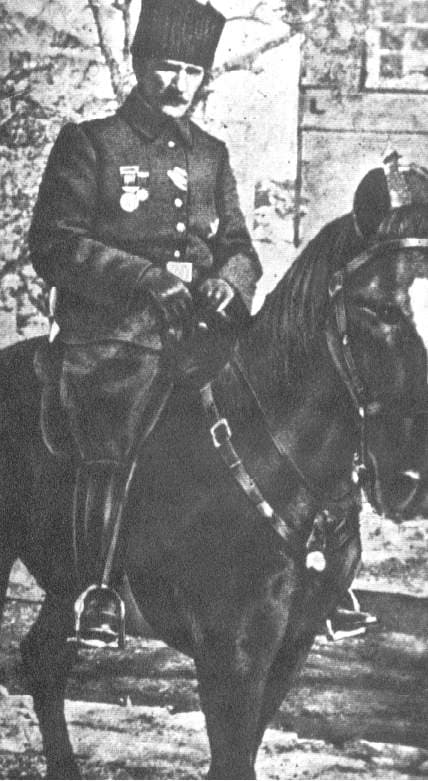
His defining military moment came at Gallipoli in 1915. When British, Australian, and New Zealand forces attempted to seize the Dardanelles Strait, Mustafa Kemal commanded the 19th Division and played a decisive role in repelling the landings at Chunuk Bair. His leadership at Gallipoli made him a national hero and the only Ottoman commander to emerge from World War I with an enhanced reputation.
He subsequently served on the Eastern Front against Russia and in Palestine and Syria against British forces. By the war's end in 1918, Mustafa Kemal was one of the Ottoman Empire's most accomplished and politically aware military officers.
The War of Independence
The armistice of October 1918 left the Ottoman Empire occupied by Allied forces. The Treaty of Sevres (1920) proposed partitioning Anatolia among Greece, France, Italy, Armenia, and Kurdistan, leaving only a rump Turkish state in central Anatolia. The sultan's government in Istanbul, effectively under Allied control, was unable or unwilling to resist.
In May 1919, Mustafa Kemal was sent to eastern Anatolia ostensibly to oversee the demobilization of Ottoman forces. Instead, he began organizing a national resistance movement. The Congresses of Erzurum (July 1919) and Sivas (September 1919) established the framework for a nationalist movement, and on April 23, 1920, the Grand National Assembly convened in Ankara as a rival government to the sultan's administration in Istanbul.
The ensuing war was fought on multiple fronts: against Greek forces advancing from the west, French forces in the south, and Armenian forces in the east. The decisive Battle of Sakarya (August–September 1921) and the Great Offensive (August 1922) drove Greek forces from western Anatolia. The armistice of Mudanya (October 1922) ended the fighting, and the Treaty of Lausanne (July 1923) established Turkey's modern borders and full sovereignty.
Founding the Republic
On November 1, 1922, the Grand National Assembly abolished the Ottoman sultanate. On October 29, 1923, it proclaimed the Republic of Turkey with Mustafa Kemal as its first president. He would hold this office until his death in 1938.
The abolition of the caliphate followed on March 3, 1924, severing the last institutional link between the Turkish state and the wider Islamic world's traditional political-religious structure. This was perhaps the most symbolically radical of all Kemalist acts, it ended an institution that had existed, in various forms, since the death of the Prophet Muhammad.
The reform era
Between 1923 and 1938, Ataturk oversaw a comprehensive program of modernization that touched virtually every aspect of Turkish life. Key reforms included:
- Legal system. Adoption of the Swiss Civil Code, the Italian Penal Code, and the German Commercial Code, replacing the Ottoman legal system based on Islamic jurisprudence.
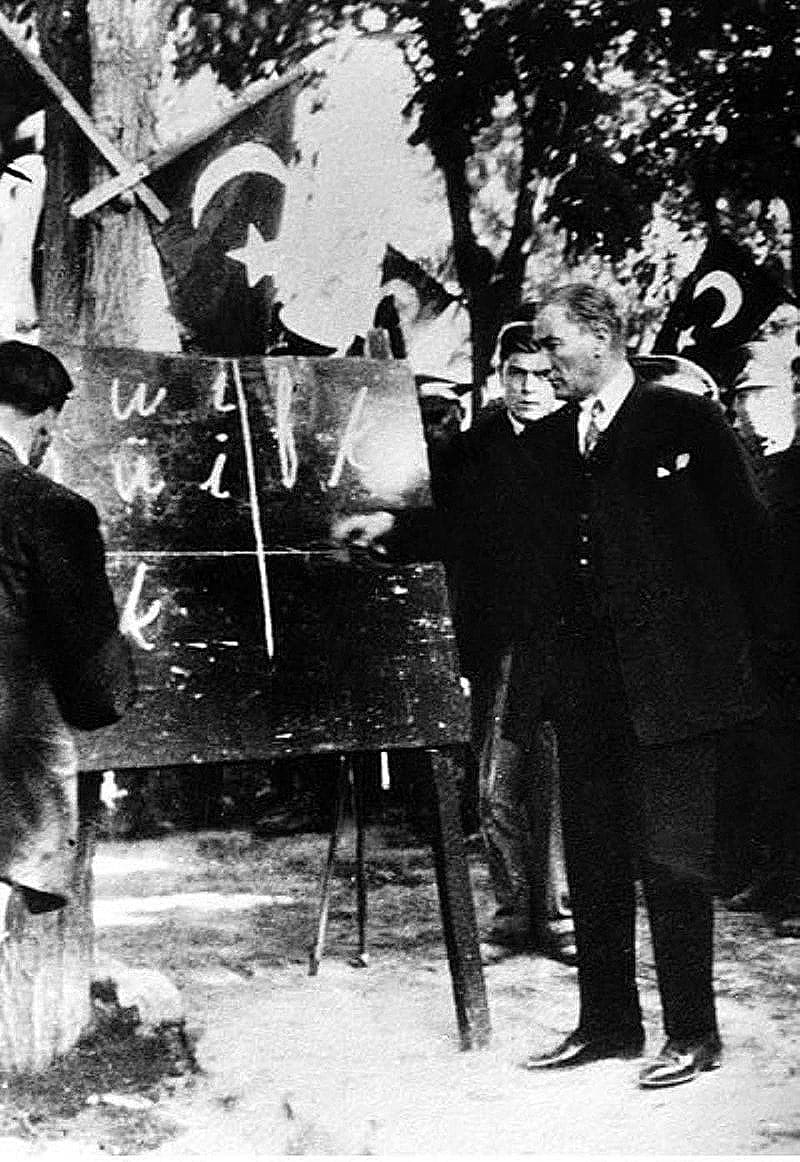
- Alphabet reform. Replacement of the Arabic script with a Latin-based Turkish alphabet in 1928, which Ataturk personally promoted in public demonstrations across the country.
- Women's rights. Women gained the right to vote in local elections in 1930 and in national elections in 1934, ahead of France and Italy.
- Education. Secularization of education, establishment of new universities, and a national literacy campaign. The traditional medrese religious schools were closed.
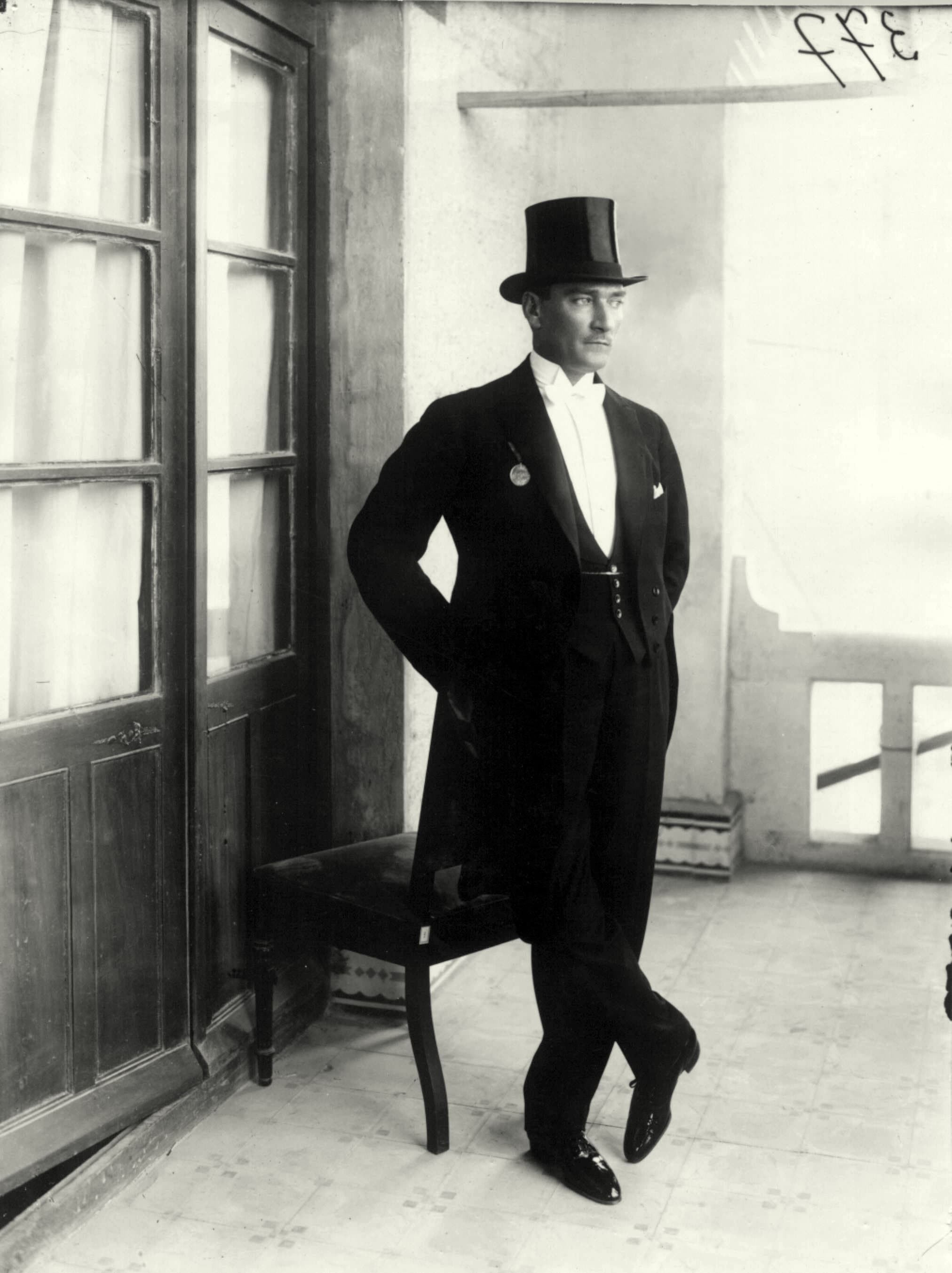
- Dress reform. The Hat Law of 1925 banned the fez and encouraged Western-style clothing.
- Calendar and measurement. Adoption of the Gregorian calendar, the international clock, and the metric system.
- Surname Law. In 1934, all citizens were required to adopt fixed family surnames. The Assembly granted Mustafa Kemal the surname "Ataturk," meaning "Father of the Turks."
Death and legacy
Ataturk's health declined in the late 1930s due to cirrhosis of the liver. He died on November 10, 1938, at Dolmabahce Palace in Istanbul, at the age of 57. His death was mourned across Turkey and internationally. Every year on November 10 at 9:05 a.m., the recorded time of his death, Turkey observes a moment of silence.
Ataturk's legacy is complex and multi-layered. To his admirers, he was a visionary who rescued a nation from partition, abolished feudal and theocratic structures, and set Turkey on a path toward modernity. His image remains ubiquitous in Turkish public life, in schools, government offices, and public squares.
Critics, from Islamists who oppose secularism to Kurdish activists who challenge the civic nationalist framework to liberals who question the authoritarian methods of the single-party era, have raised questions about various aspects of his legacy. These debates are themselves a sign of Ataturk's continuing relevance: nearly a century after his death, his ideas and their implications remain central to Turkish political life.
In less than two decades, Ataturk transformed a defeated, occupied, and collapsing empire into a sovereign republic with modern institutions.
What is broadly agreed upon is the scale of his achievement. In less than two decades, Ataturk transformed a defeated, occupied, and collapsing empire into a sovereign republic with modern institutions, a secular legal system, and a national identity capable of sustaining an independent state. Few political leaders of the 20th century can claim a comparable transformation.